
A bilingual kankotri carries the traditional Gujarati text for family and elders, and English or Hindi for friends, colleagues and relatives who don't read Gujarati. The simplest approach in a digital kankotri is one language per page: the full Gujarati kankotri, then the same content in English or Hindi. On a single page, keep Gujarati first and give both languages the same visual size. This guide covers what to translate, layouts and consistency.
Who needs which language
Many families find that one Gujarati version and one English version cover almost everyone.
Layouts
Gujarati first
In a digital kankotri, put the Gujarati pages first and the English pages after, with a clear heading such as “English”. Guests find their language at a glance.
What to translate
- The announcement: the couple's and parents' names, the wedding.
- The mangal prasango: each function with date, time and venue.
- The request: the invitation to come and bless the couple.
- The hosts: the nimantrak.
Some parts don't translate neatly, such as the shloka or the tahuko. Keep the shloka in its original script on every version. The tahuko can be translated playfully or kept in Gujarati with a short English note.
Translating the honorifics
A sample pair
The names, dates and places below are examples.
॥ શ્રી ગણેશાય નમઃ ॥
અમારા સુપુત્ર ચિ. રાહુલના શુભ લગ્ન
ચિ. સૌ. કાં. પ્રિયા સાથે નિર્ધાર્યા છે.
હસ્તમેળાપ: શનિવાર, તા. 12-12-2026, સાંજે 7:30 વાગ્યે
આપ સહપરિવાર પધારશોજી.
લિ. શ્રી દિનેશભાઈ તથા અ.સૌ. ગીતાબેન પટેલ
॥ શ્રી ગણેશાય નમઃ ॥
Mr. Dinesh and Mrs. Geeta Patel
invite you to the wedding of their son
Rahul
with
Priya
Hastmelap: Saturday, 12 December 2026, 7:30 pm
Please join us with your family.
Translating the tone
A word-for-word translation of a Gujarati kankotri can sound stiff in English, and a literal English card translated into Gujarati can sound odd to elders. Translate the meaning, not the words. Gujarati's પધારશોજી becomes “please join us”; “request the pleasure of your company” becomes આપ સહપરિવાર પધારશોજી. Each version should read naturally to its own readers.
Hindi as the second language
For families with many relatives from North India, Hindi may be a better second language than English. The structure is the same: a Gujarati version for Gujarati relatives, a Hindi version for the rest, each with the same functions, dates and names. The Hindi card matter guide has the Hindi lines.
Fonts and sizes
Choose a Gujarati font and an English font that look similar in weight and size, so neither language looks secondary. Gujarati script often needs to be set a little larger than English to look the same size. Use a Unicode Gujarati font, so the text displays correctly on every phone. The fonts guide lists good pairs.
Dates and numbers
Gujarati invitations often write dates as તા. 12-12-2026 and times as સાંજે 7:30 વાગ્યે, while English versions use “Saturday, 12 December 2026, 7:30 pm”. Both are fine; what matters is that each version is consistent within itself, and that both show the same date and time. Many families use Western numerals in both versions, since Gujarati numerals can be harder to read on a small screen for younger guests.
A page for everyone
Some families add a short English page to a Gujarati kankotri even when most guests read Gujarati, just for the essentials: the date, the time, the venue and the map. It helps the driver, the hotel staff, and the guest who reads English more easily than Gujarati, without changing the main kankotri.
Keeping both versions consistent
- The same date, time and venue in both versions, checked line by line.
- The same order of functions.
- The same names, spelt consistently across scripts.
- One person who checks both versions together before sending.
Update both
Whenever a detail changes, update both versions. A Gujarati page with the new time and an English page with the old one is the most common bilingual mistake.
Related guides
The Gujarati kankotri wording guide and the English wedding card matter guide have the full text for each language, and the kankotri format guide covers the structure. More are under kankotri and Gujarati weddings.
Questions people ask
How do I make a bilingual kankotri?
In a digital kankotri, give each language its own page, Gujarati first. On a single page, give both the same visual size.
What should be translated in a bilingual kankotri?
The announcement, the functions, the request and the hosts. Keep the shloka in its original script.
How are ચિ. and ચિ. સૌ. કાં. written in English?
There's no direct equivalent; English versions usually just use the names.
Which fonts suit a bilingual kankotri?
A Unicode Gujarati font and an English font of similar weight, with the Gujarati set slightly larger.
What's the most common bilingual mistake?
Updating a detail in one language and not the other. Check both versions together.
Ready-made wedding invitations
Open any design in the editor, put in your own names, dates and wording, and share the invitation link on WhatsApp.
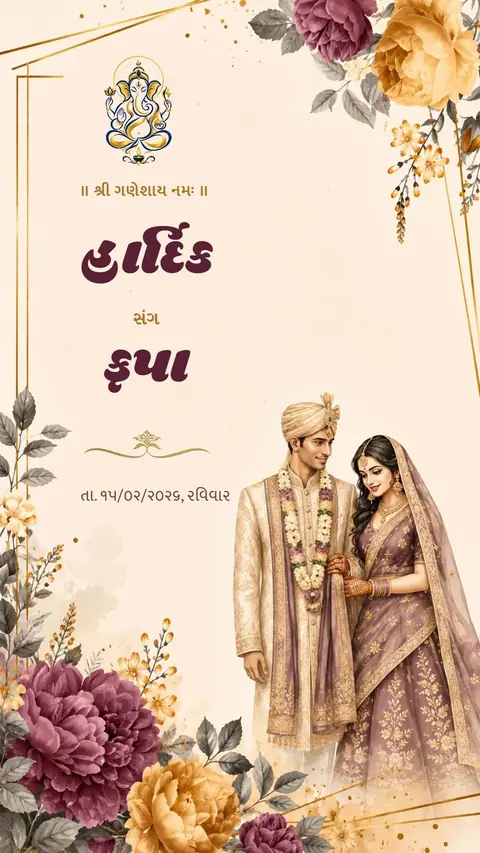 Royal Floral Wedding Invitation₹1,999inc. GST
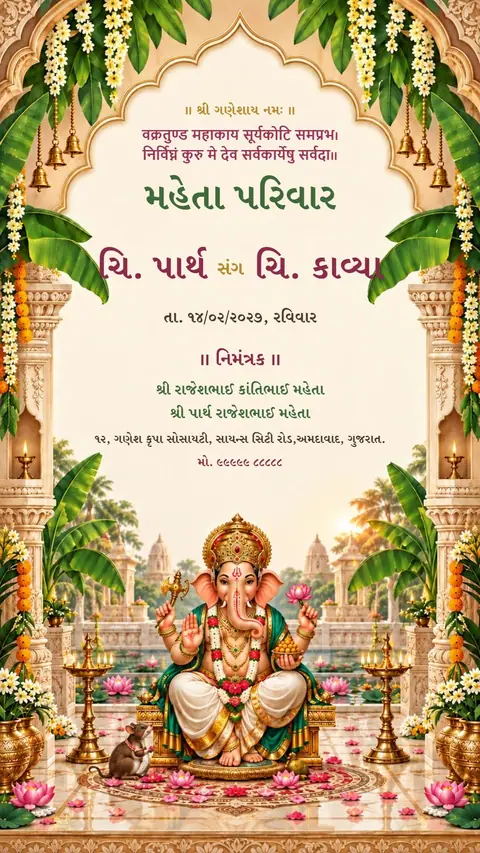 Traditional Wedding Invitation₹1,999inc. GST
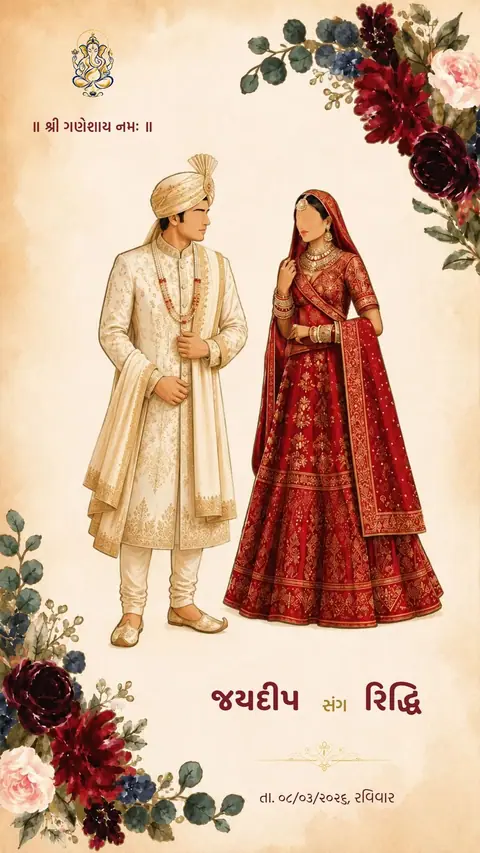 Burgundy Rose Wedding Invitation₹1,999inc. GST
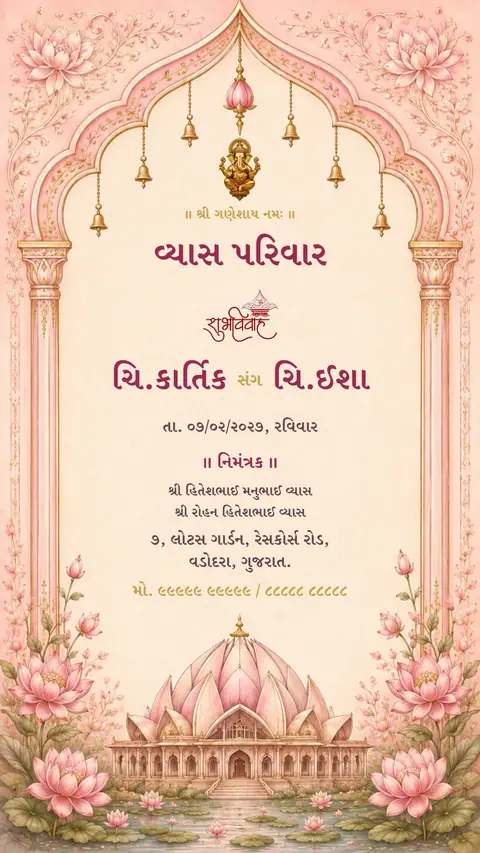 Pink Lotus Wedding Invitation₹1,999inc. GST
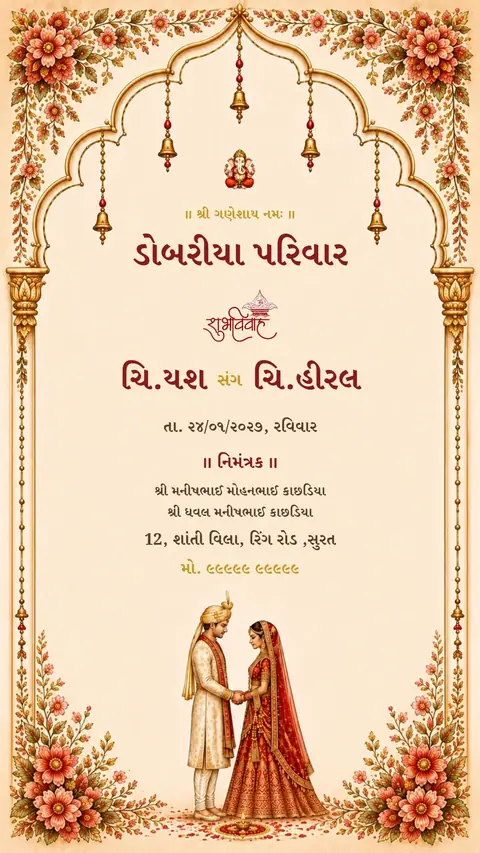 Royal Wedding Invitation₹1,999inc. GST
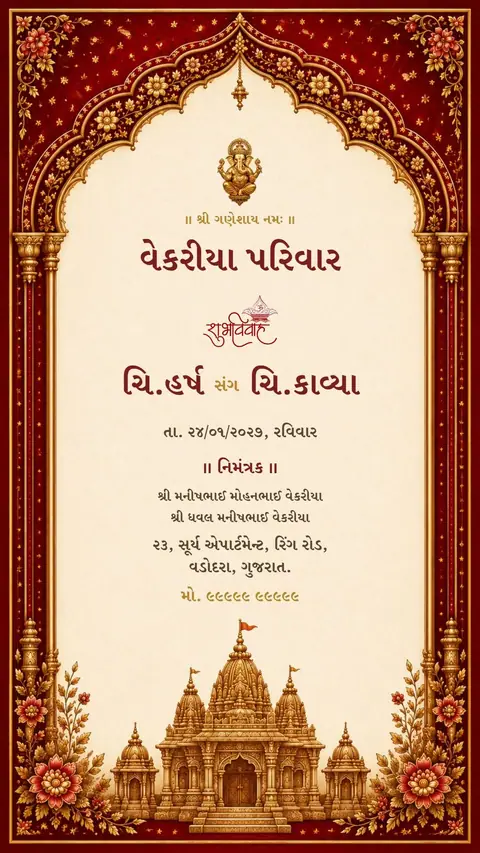 Traditional Indian Wedding Invitation₹1,999inc. GST
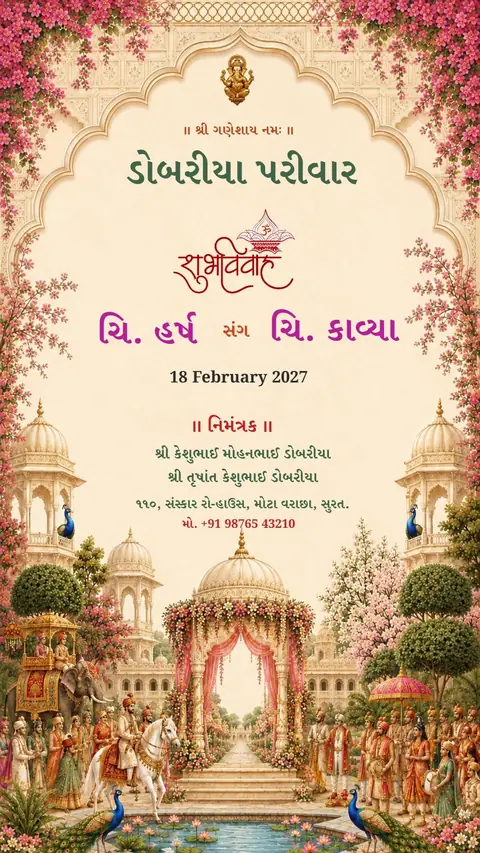 Royal Heritage Wedding Kankotri₹1,999inc. GST
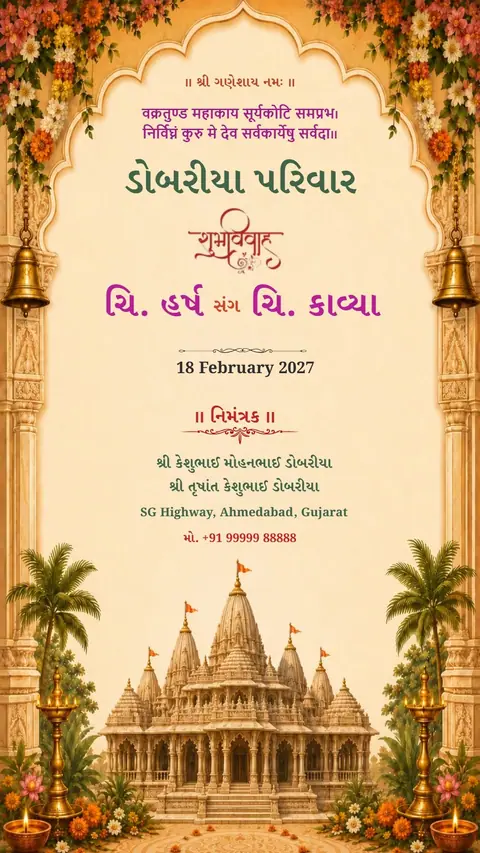 Floral Royal Garden Wedding Kankotri₹1,999inc. GST
Filed under Kankotri & Gujarati weddings
Written by ShubhLink Editorial Team
The team behind ShubhLink's invitation templates and ShubhLink AI. We write down what families ask us most, and check each guide before it goes live.